
For years, SEO has often been treated as something that happens towards the end of a website project.
First comes the strategy. Then the sitemap, copy and design. The website gets built. And somewhere before launch — or sometimes several months afterwards — somebody asks: “What about SEO?”
We think that order needs to change.
As search becomes increasingly shaped by AI-powered discovery, the decisions that influence your visibility aren't limited to keywords, page titles or technical settings added once the website is finished. They start much earlier, with decisions about which pages your website needs, how you structure your services, what your business should be known for, and how much useful information you give both potential customers and search systems to work with.
This is something we've been exploring extensively at Visuable, first through rebuilding and optimising our own website and then through the SEO and AI visibility work we've been carrying out for clients.
Our conclusion has changed the way we approach website projects.
If you're investing in a new website today, SEO and AI visibility shouldn't be the final layer. They should help shape what you build.
A beautiful website can still be difficult to discover
We love beautiful websites. We're a design studio, after all.
But design can only solve part of the problem.
A website might have exceptional typography, thoughtful animation and a perfectly curated portfolio, but if the structure doesn't reflect what people are searching for, important services are hidden inside broad pages and the copy never clearly explains what the business actually specialises in, there is only so much optimisation you can do afterwards.
We've seen this repeatedly when working on existing websites.
Sometimes a business wants to improve its SEO and we discover that three strategically important services have been squeezed onto a single page. Sometimes the website uses language that sounds beautiful from a branding perspective but bears very little resemblance to the language customers use when searching. Sometimes valuable expertise exists within the business but isn't represented anywhere on the website.
None of those problems can be solved particularly well by changing a meta description.
They are website strategy problems.
And as we started thinking more deeply about AI visibility, that distinction became even more important.
AI search makes website strategy more important, not less
In our wider guide to AI optimisation and the changing search landscape, we explain our view that AI visibility is fundamentally about reducing ambiguity around a business.
Search engines and AI-powered discovery systems need information. They need to understand what a business does, who it helps, what subjects it has genuine expertise in and how the different pieces of information surrounding that business connect.
Your website isn't the only source of that information, but it is one of the few digital spaces you completely control.
That makes the structure of the website incredibly valuable.
A homepage can establish the business and its positioning. Dedicated service pages can create depth around individual areas of expertise. About and team pages can explain the people behind that expertise. Case studies can demonstrate it in practice. Articles can explore it through original thinking. FAQs can answer the more specific questions potential customers are asking.
When those elements are planned together, a website becomes much more than an online brochure. It becomes a structured body of information about the business.
This is why we don't think the answer to AI search is simply “add some schema to your existing website”.
Schema can be useful, but the underlying website still needs to have something meaningful to describe.
Start with what you want to be found for
One of the most useful questions we can ask before designing a website is deceptively simple:
What does this business actually want to be found for?
Not what should the navigation look like. Not which website template do we like. Not whether the homepage should have a video.
What do we want the right people to discover this business for?
Keyword research helps us answer part of that question because it gives us evidence about how people are searching. It can reveal terminology customers use that is different from the terminology used internally by the business. It can show us that one service deserves its own page rather than a paragraph hidden halfway down another one. It can reveal related questions and topics that potential customers are already researching.
But search volume isn't the only consideration.
We also need to understand where the business wants to grow.
A company may have a profitable service that isn't currently generating much organic search traffic because the existing website barely talks about it. Another might want to move into a new market or attract a more specific type of client. A founder might have significant expertise in an area that simply isn't visible online.
This is where SEO becomes part of business and website strategy rather than a technical exercise.
The research helps us decide not simply how to optimise the pages, but which pages should exist in the first place.
Your sitemap is part of your SEO strategy
A sitemap can look like a very simple document: Home, About, Services, Portfolio, Blog, Contact.
But those decisions have consequences.
Imagine a business offering five distinct services but placing all of them on one general “Services” page. From a minimalist design perspective, that might seem perfectly sensible. From a search perspective, however, we need to ask whether each of those services represents a different search intent and whether potential customers need more information before making a decision.
If they do, dedicated pages may create a much stronger website.
Each service can then have its own purpose, keyword focus, content hierarchy, FAQs, examples and internal links. The website becomes easier for customers to navigate because they can go directly to the service relevant to them, while search engines receive a much clearer understanding of the different areas the business covers.
That doesn't mean more pages are automatically better.
We don't advocate creating dozens of thin pages simply to target variations of the same keyword. Every page needs a reason to exist for the person visiting it.
The goal is to find the point where customer journey, business strategy and search intent meet.
That's where website architecture becomes genuinely strategic.
Copy needs to work for people and search systems
Once the structure is right, the language becomes equally important.
This is an area where branding and SEO have sometimes been treated as opposing forces. Brand copywriters want personality; SEO specialists want keywords. The result can be a tug of war between copy that sounds beautiful but says very little and copy that ranks every conceivable keyword in the first 200 words but doesn't sound remotely human.
We don't think businesses should have to choose.
Strong website copy should make someone feel something about your brand while also making it very clear what you do.
If a potential customer has to read six paragraphs before they can work out what service you're selling, that isn't simply an SEO issue. It's a communication issue.
The same clarity that helps search systems understand a page often helps people understand it too.
This is why keyword research informs our website copy and content planning without dictating every sentence. We want to understand the language customers are using, then translate that insight into copy that still feels distinctive, natural and true to the brand.
Build the evidence into the website
AI visibility has also made us think differently about proof.
Businesses often make broad statements such as “we're experts”, “we deliver exceptional results” or “we have decades of experience”. Those claims might be completely true, but they become far more powerful when the website contains evidence behind them.
A case study can show what you actually did. A founder biography can explain where expertise comes from. A portfolio can demonstrate the type and quality of work you have produced. An article can reveal how you think about a problem. A detailed service page can demonstrate that you understand the nuances of what you're selling.
This isn't about adding content simply because more content must be better.
It's about making expertise visible.
We saw this clearly while working on the website and SEO strategy for Raccoon, where an extensive portfolio of client projects and photographer biographies became valuable assets in creating a richer digital picture of the agency.
When we're planning a new website now, we therefore ask not only, “What information does the customer need?” but also, “What evidence does this business already have that isn't being used?”
Often, the raw material for a much stronger website already exists inside the business.
Structured data works better when the structure already makes sense
This is also where organisation and entity schema enter the picture.
As we explain in our complete guide to AI optimisation, structured data can help machines interpret information about a company and the relationships surrounding it. But schema works best when it reflects a website and digital presence that are already clear.
If we've deliberately structured a website around the company's core services, clearly introduced its founders, created meaningful case studies and established consistent company information, structured data has something substantial to reinforce.
That is a very different situation from trying to use schema to compensate for a vague website.
It's why we increasingly prefer to consider entity information while we're planning a website rather than treating it as a technical addition after launch.
Retrofitting SEO is possible. Designing with it is better.
We optimise existing websites all the time, so this isn't an argument that a website without an SEO strategy needs to be rebuilt.
Often, we can make significant improvements to an existing site.
But there are limits.
If research shows that a business needs four service pages and the current website has nowhere logical to put them, we're changing the architecture. If the navigation no longer reflects the business, we're changing the user experience. If the copy needs to communicate a completely different positioning, we're changing the content strategy.
At some point, optimisation starts becoming reconstruction.
If you're already planning a new website, it makes much more sense to answer those questions before design begins.
We can use search insight to inform the website rather than asking the finished website to accommodate the search strategy afterwards.
That distinction is at the heart of our new AI SEO website packages.
Two ways to build SEO and AI visibility into a new website
Not every business needs the same type of website.
Some businesses need a strategic, beautifully designed website and strong SEO foundations, but don't need a completely bespoke design process. Others have more complex services, audiences or conversion journeys that require the website architecture, content and design to be created around them from the ground up.
We've created two AI SEO website options around those different needs.
AI SEO Framework Websites
Our AI SEO Framework Website combines one of our strategic Squarespace website frameworks with SEO and AI visibility planning.
The framework gives us a considered design and UX foundation, which means we don't need to spend project time reinventing every layout from scratch. Instead, we can focus more of the investment on adapting that framework to your business, content, brand and search strategy.
SEO isn't something we add once the website has been designed. Keyword research helps inform the pages and content, while AI visibility considerations influence how clearly the business, services and expertise are represented. Company information, FAQs, external profiles and organisation entity schema are considered as part of the wider digital picture rather than disconnected technical tasks.
It's a good fit for businesses that want to launch a professional, strategic website with SEO and AI visibility built into the foundations, but don't need the scope of a completely custom website.
AI SEO Custom Websites
Our AI SEO Custom Website is designed for businesses that need a more individual strategy.
Here, we start with the business rather than a predefined website framework. We can look more deeply at competitors, keyword opportunities, content gaps, customer journeys and conversion goals before determining the structure the website needs.
That research informs the sitemap and page strategy, which then informs the copy, UX and custom design.
SEO and AI visibility become part of the architecture of the website itself.
This route gives us more freedom to create dedicated landing pages, deeper service structures, bespoke conversion journeys and a content ecosystem around the areas the business wants to grow. We can then connect those foundations with organisation schema, FAQs, relevant external profiles and an ongoing SEO and AI roadmap.
It's particularly useful for established businesses whose website needs to support a more complex offer or a significant next stage of growth.
Framework or custom: which approach do you need?
The difference isn't simply that one website is “smaller” and the other is “bigger”.
It's about how much needs to be invented specifically for your business.
If your business model is relatively straightforward and one of our strategic frameworks already provides the structure and functionality you need, starting from that foundation can be an efficient way to invest more of the project into content, SEO and visibility.
If your offer is more complex, you're repositioning the business, entering new markets, targeting several distinct audiences or need a more sophisticated conversion journey, a custom strategy gives us much more room to solve those problems through the website itself.
In both cases, the principle is the same.
We don't want to design a website and then ask how people are going to find it.
We want discoverability to be part of the conversation from the beginning.
A website should launch with somewhere to go next
There's one final reason we've started bringing SEO and AI visibility more deeply into website projects: launch day isn't the finish line.
A new website gives a business a stronger foundation, but search visibility develops over time.
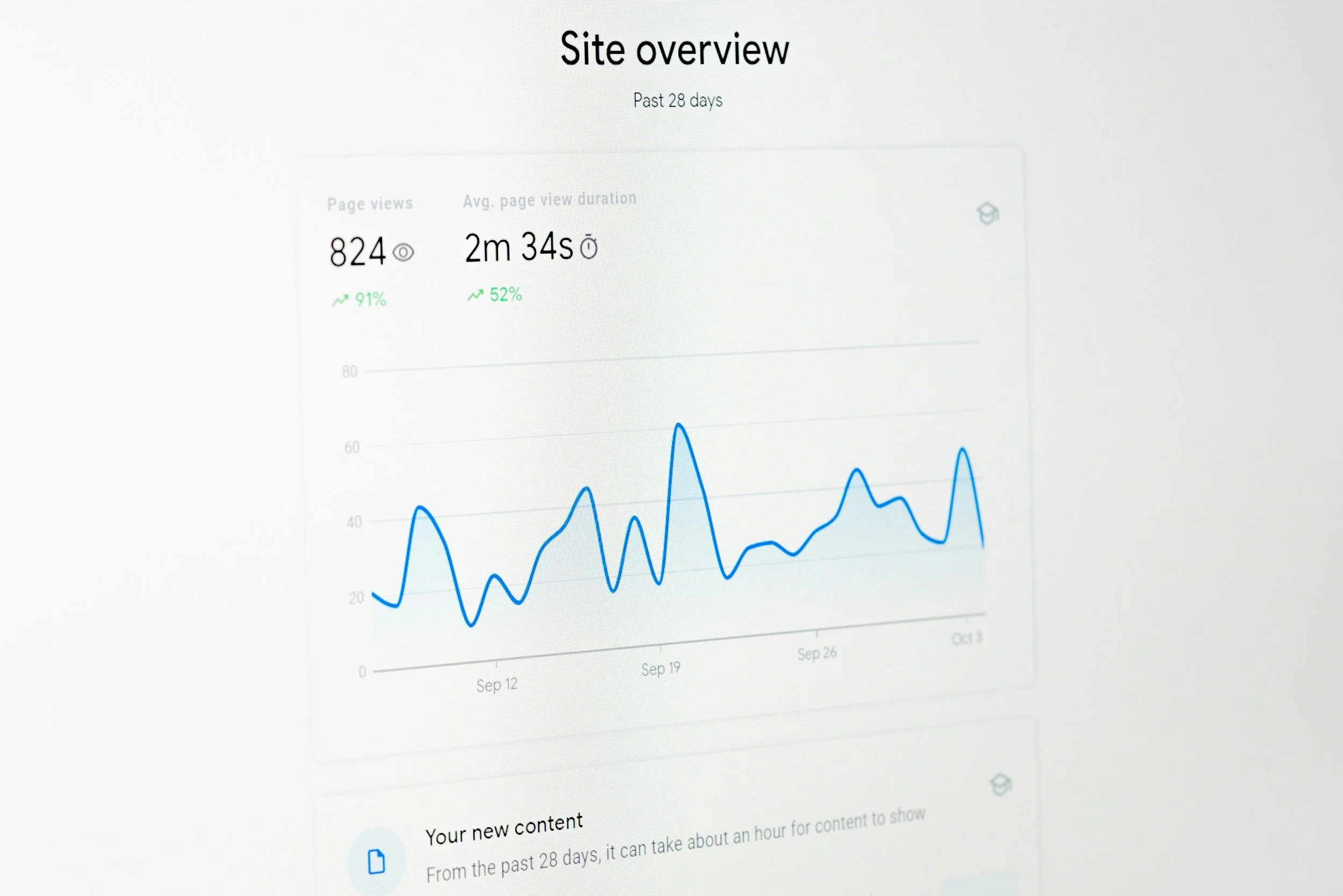
Once the website is live, Search Console starts giving us more information. Pages begin appearing for new searches. We can see where impressions are growing, where opportunities exist and what questions might deserve new content. The business itself continues evolving too, creating new projects, developing new expertise and earning new mentions elsewhere.
That is why our AI SEO website packages don't treat optimisation as a launch checklist.
The website establishes the foundation. The strategy should continue from there.
The strongest businesses will keep adding useful evidence of their expertise, refining important pages, publishing genuinely valuable content and strengthening the wider digital presence surrounding the website.
In other words, the website isn't the entire AI visibility strategy. It's the place where much of that strategy begins.
Building a website now means building for a different search landscape
We can't know exactly what search will look like five years from now.
AI platforms will evolve. Google will continue changing. New interfaces will appear, and the way people research businesses will keep shifting.
Trying to design a website around one particular AI platform would therefore be a very short-term strategy.
We think there is a better approach.
Build a website with strong technical foundations. Give important services enough depth. Use language your customers actually understand and search for. Make expertise visible rather than merely claiming it. Connect the people, work and ideas behind the business. Give search systems structured information where it is useful. And create a website that can continue growing as the business does.
Those are good SEO principles.
They're good AI visibility principles.
More importantly, they're the foundations of a genuinely useful website.
And if you're investing in a new website now, this is the moment to build them in — not something to add when the design is already finished.
Planning a new website?
Our AI SEO Framework Website and AI SEO Custom Website packages bring website strategy, design, SEO, and AI visibility into one process from the start.
Choose a strategic framework for an efficient route to a beautifully designed, search-ready website, or work with us on a custom website when your business needs a more bespoke strategy, architecture, and customer journey.
FAQs
-
An AI SEO website is a website planned and built with both traditional search and AI-powered discovery in mind. Rather than designing the website first and adding SEO afterwards, keyword research, website architecture, content depth, FAQs, structured data and wider AI visibility considerations can inform the project from the beginning. At Visuable, we don't see this as a completely new type of website. It's an evolution of good website and SEO strategy for a changing search landscape.
-
Many of the foundations are the same. Both need a clear structure, useful content, strong technical SEO and pages built around relevant search intent. An AI SEO approach expands the picture by considering how clearly the website communicates the business itself: its services, audiences, expertise, people, experience and relationships with information elsewhere online. The aim is to create a website that is easy for people, search engines and AI-powered discovery systems to understand.
-
Ideally, SEO should begin before the website is designed. Keyword and competitor research can reveal which pages the website needs, how services should be organised and what information potential customers are searching for. That insight can then inform the sitemap, page strategy, copy and user experience. SEO can absolutely be added to an existing website, but incorporating it earlier gives it the opportunity to shape the website rather than simply optimise what has already been built.
-
You can build a website with stronger foundations for AI-powered discovery, but nobody can guarantee that a business will appear in ChatGPT or another AI platform's answers. We focus instead on the factors a business can influence: clear website architecture, useful and specific content, strong SEO foundations, visible expertise, structured company information and a consistent wider digital presence.
-
Structured data can form a useful part of an AI SEO website because it gives machines additional information about the content and organisation behind the website. Organisation and entity schema can help clarify information about the business and its relationships, while FAQ and other relevant schema can provide additional structure to specific content. However, schema works best when the website itself is already clear and comprehensive. It isn't a substitute for good content or website strategy.
-
Not necessarily. The right approach depends on the complexity of your business and what the website needs to achieve. Our AI SEO Framework Websites use a strategic Squarespace framework as the design and UX foundation, allowing more of the project to focus on your business, content, SEO and AI visibility. Our AI SEO Custom Websites are better suited to businesses that need a more bespoke architecture, content strategy, customer journey and design.
-
Both approaches bring SEO and AI visibility into the website process from the beginning. A Framework Website starts with one of our strategic website frameworks and adapts it to your brand, content and search strategy. A Custom Website begins with a deeper exploration of the individual business and gives us more freedom to develop the sitemap, customer journeys, page strategy, UX and design around its specific needs.
-
Yes. A new website isn't automatically necessary just because you want to improve your AI visibility. Existing websites can often be strengthened through better SEO, clearer content, improved page structures, FAQs, organisation schema and external visibility work. A rebuild becomes more relevant when the underlying architecture, content or user experience no longer supports where the business needs to go.
Related Blogs