AI Optimisation: How to Make Your Business Easier for AI to Find, Understand and Recommend
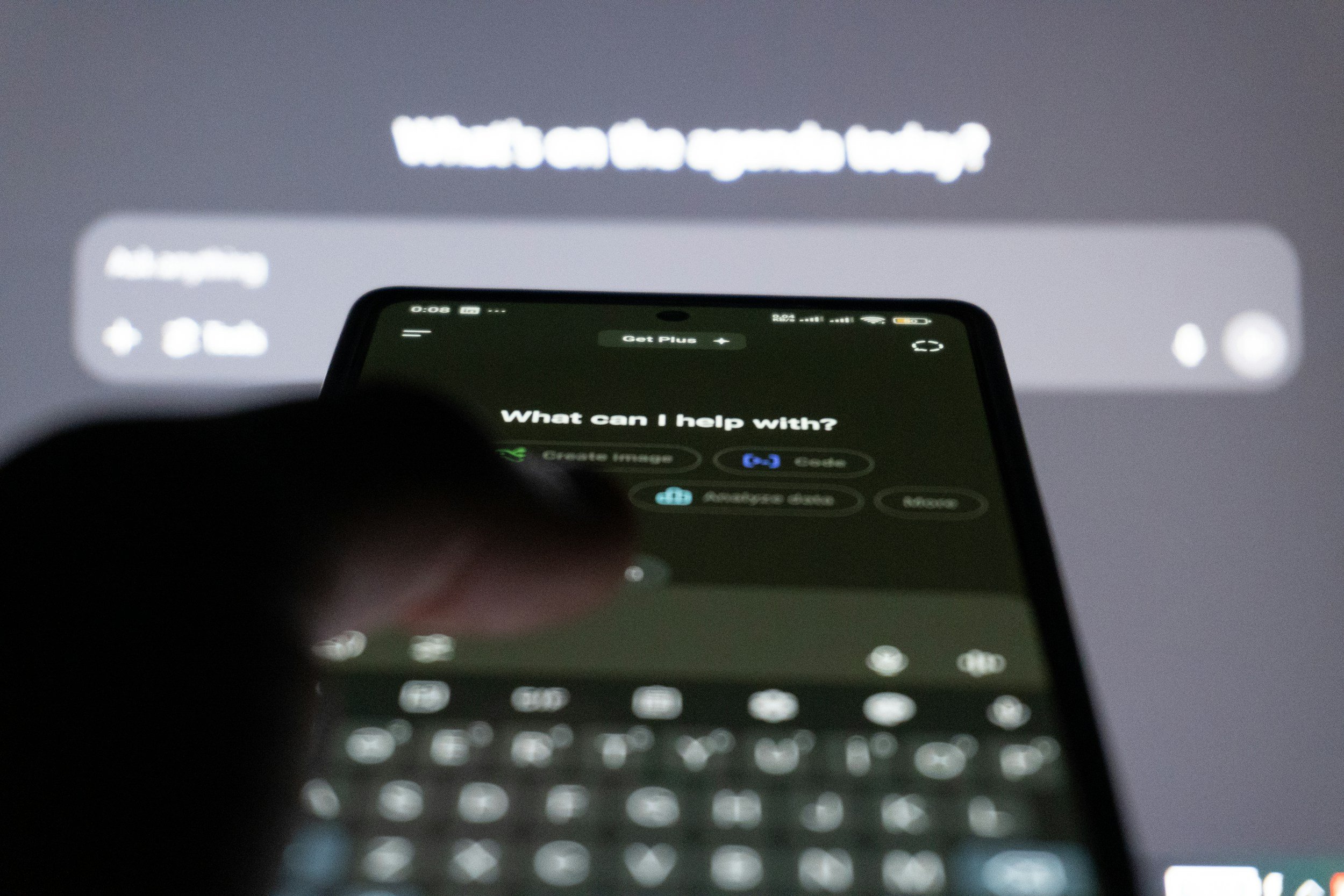
For a long time, online visibility was relatively straightforward to understand. Someone typed a query into Google, Google returned a list of websites, and SEO helped businesses improve their chances of appearing among them. That journey hasn't disappeared, but it is becoming much less linear. Someone looking for a branding agency, photographer, consultant or interior designer might still begin with Google. Still, they could just as easily ask ChatGPT for recommendations, use Google's AI-powered search features to research their options, or turn to another AI platform to compare services before they ever reach a traditional search results page.
This shift has created a whole new vocabulary around search. We now hear about AIO, AEO, GEO, and Generative Engine Optimisation, often accompanied by claims about the tactics businesses supposedly need to adopt to stay visible. But after working on AI optimisation for our own website and incorporating it into our clients' SEO strategies, we've come to a slightly different conclusion.
AI optimisation isn't about learning an entirely new set of tricks. It's about making your business exceptionally easy to understand, verify, and trust.
In many ways, the rise of AI-powered search hasn't made the principles behind good SEO less relevant. It has made them more important. Clear positioning, well-structured websites, useful content, credible expertise and a strong digital footprint all help search engines understand a business. Increasingly, those same foundations also matter when businesses want to be discovered through AI-powered search. The way people search online is changing, and for businesses that have spent years investing in SEO, it raises an obvious question: what happens when your potential customers start asking AI instead of searching Google?
The difference is that we now need to think beyond rankings alone.
What is AI optimisation?
AI optimisation describes the work businesses can do to improve how clearly their brand, expertise, services and content can be understood across AI-powered discovery experiences. You may also see this referred to as Generative Engine Optimisation, Answer Engine Optimisation or AI Search Optimisation. The terminology is still evolving, and different platforms work in different ways, which is precisely why we're cautious about treating any one acronym as a completely new marketing discipline.
Google's own guidance offers some useful perspective here. Its AI-powered search experiences continue to rely on many of the same foundations as traditional search, and Google advises businesses to focus on established SEO practices rather than looking for special tricks designed specifically for generative AI.
That reflects what we've seen in our own work. Good AI optimisation starts with good SEO, but it expands the picture.
Traditional SEO asks whether search engines can crawl and index your website, whether your pages target topics people are actually searching for, whether your website has a logical structure and whether the content satisfies search intent. Those questions haven't gone away. AI optimisation simply encourages us to ask a wider set of questions alongside them.
Does your website make it immediately clear what your company does and who you work with? Are your services described consistently? Is there enough depth for someone — or a machine — to understand what you specialise in rather than simply knowing that you exist? Can your expertise be verified through your work, your people and your wider digital footprint? Are there credible sources outside your own website that reinforce the information you provide about your business?
Once we started looking at AI optimisation through that lens, it became much more interesting than simply asking how many times a keyword should appear on a page or which piece of schema we should install.
We think AI optimisation is really about reducing ambiguity
One of the biggest lessons from optimising our own website has been that clarity is becoming an increasingly valuable digital asset.
Consider a consultancy whose homepage tells you that it provides “transformative solutions for ambitious businesses looking to unlock their potential”. It sounds polished, but it doesn't tell you very much. What kind of consultancy is it? What does it actually help businesses do? Which industries does it understand? Where does it operate? What expertise does its team have? What evidence is there that it has successfully done this work before?
A potential client has to work quite hard to answer those questions. Search systems have to make sense of the same ambiguity.
Now imagine another business whose website clearly explains what it does and who its services are designed for. Each core service has a detailed page. The founders and team have useful biographies explaining their experience. Client projects show the work in practice. FAQs answer genuine questions potential customers ask before buying. Articles demonstrate expertise in the subjects the company wants to be known for. Elsewhere online, credible profiles and directory listings reinforce the same positioning.
The second business has created a much clearer digital picture of itself.
This is increasingly how we think about AI optimisation at Visuable. Rather than asking how we can optimise a website “for AI”, we ask how we can remove uncertainty around the business behind the website.
That change in perspective has important implications, because it means AI visibility isn't purely a technical SEO exercise. Your positioning matters. Your website architecture matters. Your copy matters. Your case studies and team biographies matter. Your external profiles matter. Even the way you describe the business consistently across different parts of the internet can contribute to a clearer picture of who you are and what you should be known for.
How does AI optimisation actually work?
There isn't a single setting that turns a website into an AI-optimised website. We see it as a collection of connected signals that make a business and its expertise easier to discover and understand.
The starting point is still technical SEO. Before we think about AI visibility, we want to know that important pages can be crawled and indexed, that the website architecture makes sense, that search engines can access the content and that technical issues aren't undermining the work happening elsewhere. Google's own documentation around AI search reinforces this: pages still need to meet the technical requirements of Google Search if they are going to appear as supporting links within its AI experiences.
Once those foundations are in place, the focus moves towards the information itself. We use keyword research to understand how people describe their needs, the terminology they use and the questions they ask. That information then helps us create a clearer structure for individual pages. A well-optimised service page shouldn't simply repeat a target keyword. It should create a complete picture of the service: what it is, who it is for, what problem it solves, how the process works and what someone needs to know before deciding whether it is right for them.
This is also why we've become increasingly interested in the relationship between SEO and brand positioning. You can technically optimise a page perfectly and still leave a reader unsure what makes the business relevant to them. Equally, you can write beautiful brand copy that gives search engines very little concrete information to work with. The strongest websites do both. They communicate with personality while remaining specific enough to be understood.
When we worked on our own AI optimisation, this became one of our priorities. Instead of trying to make individual pages relevant to dozens of loosely connected ideas, we focused on giving each page a clearer subject and purpose, supported by meaningful headings, internal links and related content.
We documented more of that process in how we achieved a 100% AI optimisation score, including the changes we made and the areas we discovered still needed work.

Not sure what AI sees when it looks at your business?
You don't need to become an expert in schema, entities or Generative Engine Optimisation to prepare your business for AI search. That's our job. Our Complete SEO + AI Visibility service looks at the bigger picture — from your technical SEO and website content to organisation schema and the external signals surrounding your brand — and turns it into a clear, practical strategy.
Why FAQs have become more valuable — when they're actually useful
FAQs are another area where SEO and AI optimisation naturally overlap, but they're also a good example of where we think businesses need to avoid formulaic optimisation.
We don't believe every service page needs five generic questions added to the bottom simply because somebody has said that “AI likes FAQs”. What matters is whether those questions make the page more complete.
When we research FAQs, we're looking for the questions a potential customer might genuinely ask while making a decision. They may want to understand what a service includes, how long the process takes, whether it is suitable for a particular type of business, how two similar services differ, or what happens after the initial project is complete. Answering those questions creates a richer resource for the customer while giving search systems more explicit information about the topic.
This is particularly relevant as search becomes more conversational. Traditional keyword searches are often short and fragmented. AI allows people to ask much more detailed questions in natural language, adding context about their business, priorities and circumstances. Content that anticipates those deeper questions therefore becomes increasingly useful.
The principle we follow is simple: an FAQ should exist because the answer adds value, not because we want another place to insert a keyword or a piece of schema.
What is organisation and entity schema?
Schema is one of the more technical elements of AI optimisation, and perhaps one of the most misunderstood.
At its simplest, schema is structured data added to a website's code to help machines interpret information on the page. The visible website communicates with the person visiting it; structured data provides an additional machine-readable description of certain information.
Organisation schema can include information about a company such as its name, website, description and other identifying details. Google describes organisation structured data as a way to help it understand administrative and identity information about an organisation and distinguish it from other entities.
The concept becomes more useful when we think beyond an isolated piece of code and start thinking about the entity behind the website.
An entity is essentially a recognisable thing that can be understood and connected to other information. A company is an entity. A founder can be an entity. A service, organisation or place can also be an entity. From an AI optimisation perspective, we're interested in how clearly those relationships are established.
For a business, we might want to make the relationship between the company, its services, its target audience, its founders or team, its external profiles and relevant PR or authority signals clearer. The organisation schema helps provide structured information, while the rest of the website supplies the depth and context through service pages, biographies, case studies, FAQs and expert content.
This is why consistency becomes so important. If your homepage describes the company one way, your LinkedIn page uses positioning you abandoned three years ago, your directory profiles put you into completely different categories and your website barely mentions the expertise you want to be known for, the digital picture of the company becomes fragmented.
Organisation schema can help us clarify that picture, but there is an important caveat.
Schema is not a magic AI visibility button.
Google explicitly states that businesses don't need special AI-specific schema to appear in its generative search experiences. Structured data remains useful because it can help machines understand information, but it shouldn't be confused with a shortcut to AI recommendations.
Our view is that schema works best as one part of a much broader strategy. It can clarify information, but it cannot manufacture expertise or authority that isn't there. If a website has vague services, thin content and very little evidence of experience, adding a sophisticated schema implementation isn't suddenly going to make the business an authoritative source.
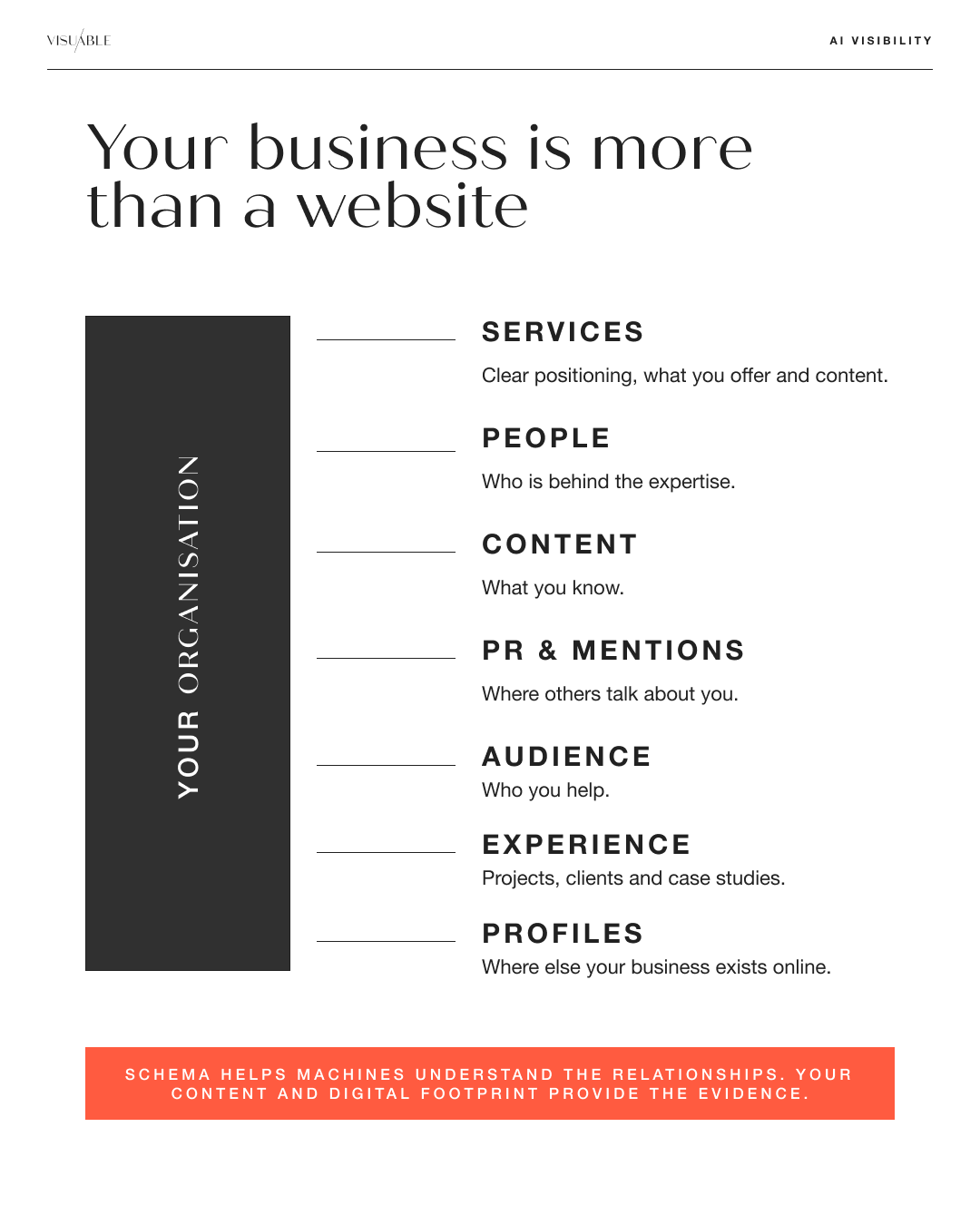
Your website is only one version of your business
This is one of the areas where our thinking has evolved most as we've worked on AI visibility.
Historically, SEO projects have often concentrated heavily on the website itself. We optimise pages, improve metadata, fix technical problems, build content and monitor rankings. All of that remains valuable, but AI-powered discovery encourages us to consider the wider information environment around a business as well.
Your website tells the internet what you say about your company. But what information exists about you elsewhere?
Perhaps your business has an established LinkedIn presence. Maybe you belong to relevant professional directories. Your founders may have biographies on conference websites, podcast appearances or articles elsewhere. Your work could be featured by industry publications. Customers may review your business on third-party platforms. You might have years of credible information online, but none of it clearly connects back to the positioning on your current website.
We think those external signals deserve more attention.
This doesn't mean submitting a company to hundreds of directories or trying to manufacture mentions purely for AI visibility. In fact, that would run counter to the quality-first approach we take to SEO. Instead, we're interested in credible places where it genuinely makes sense for the business to appear and making sure the information there is accurate, useful and consistent.
This is why third party profiles and directory optimisation now forms part of our AI visibility work. The website remains the centre of the strategy, but we increasingly think about the digital footprint surrounding it.
What we learned from optimising the Visuable website for AI search
We didn't want to build an AI optimisation service entirely from theory, so Visuable became one of our first experiments.
When we decided to rebuild our website, we treated ourselves in much the same way we would treat a client. We stepped away from what we thought we knew about the site and looked at it strategically: which pages were performing, what people were searching for, where our positioning had evolved, which services needed more depth, where we had authority that wasn't being communicated clearly and how the structure of the website could better reflect what Visuable had become.
The project went much further than changing a few keywords. We rebuilt our service architecture, created more detailed industry-specific content, strengthened internal linking, refined our messaging and introduced additional information designed to make our services and expertise clearer. We also started thinking much more deliberately about how the information surrounding Visuable could help establish a consistent understanding of the company.
We wrote about the complete process in why we rebuilt the Visuable website for the AI search era.
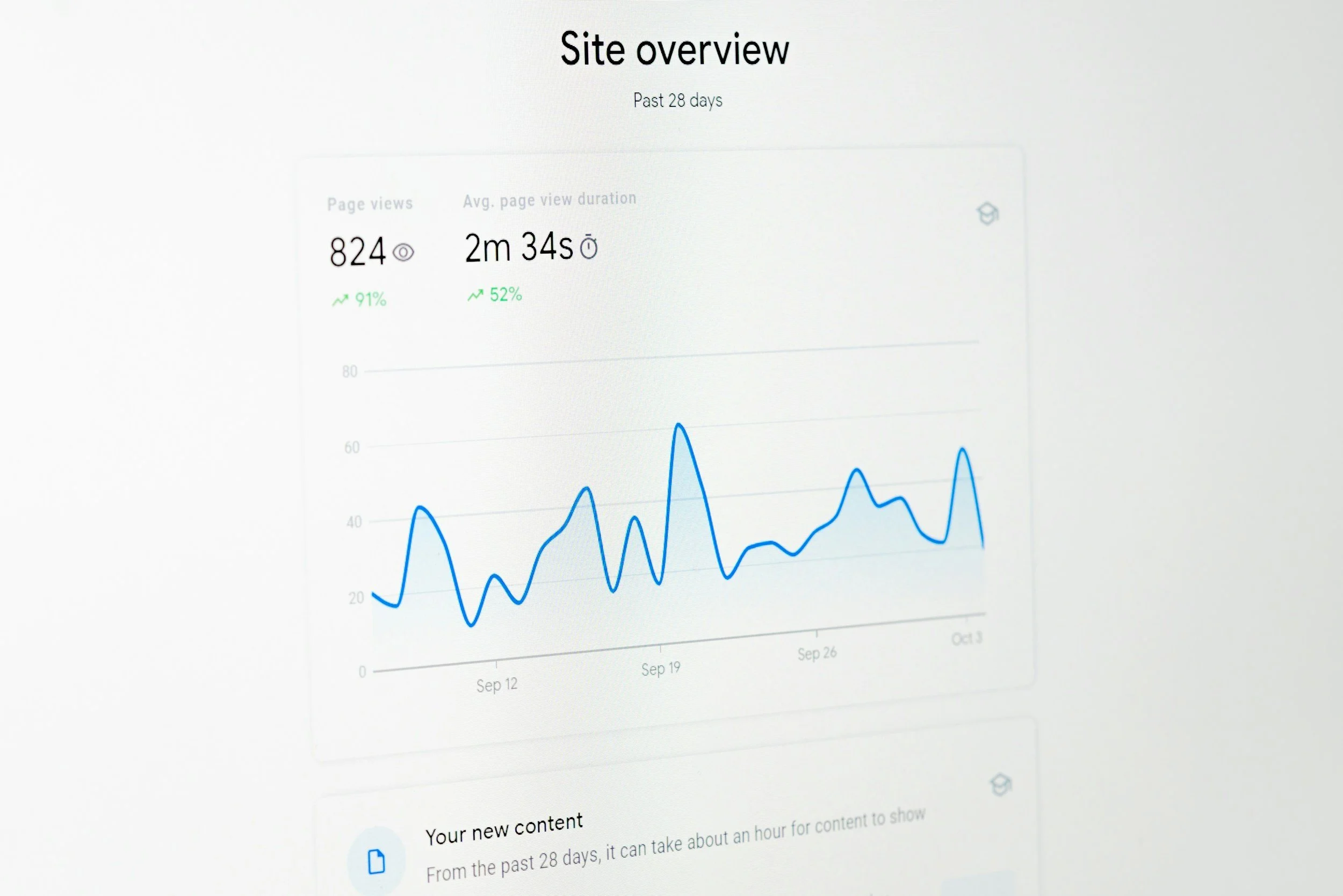
The early results were encouraging. Within six weeks of launching the rebuilt website, page views increased from 10,595 to 13,269, while key enquiry actions increased from 491 to 693 — a 40% increase. We also recorded a 114.9% increase in ChatGPT mentions, reaching 159 monthly mentions, and achieved a 100% AI search visibility score in the platform we were using to benchmark the site.
Those numbers need to be interpreted carefully. We wouldn't claim that a particular schema implementation caused a certain percentage increase, or that changing a heading suddenly made ChatGPT mention us. Search visibility has never been that simple, and AI visibility certainly isn't.
What the results did reinforce was something we've believed for a long time: a website performs best when all of its different disciplines work together rather than in isolation.
Strategy informs what the business wants to be known for. Copy turns that strategy into clear language. SEO connects that language to what people are actually searching for. Website structure helps people and machines navigate the information. Case studies and expert content demonstrate that the business has real experience behind its claims. Schema adds another layer of clarity, while a consistent external presence helps reinforce the bigger picture.
AI hasn't replaced any of those things. It has simply given us another reason to connect them.
What Raccoon taught us about AI optimisation at scale
Our work with Raccoon gave us the opportunity to apply many of the same ideas to a very different type of website.
Raccoon is a global creative production agency with an extensive body of work and a website that had already been generating valuable inbound enquiries for years. The challenge wasn't simply to create more visibility. We needed to migrate and restructure a substantial Squarespace website while protecting the search equity it had already built.
Our SEO and AI optimisation strategy covered 75 core pages, combining content auditing, detailed keyword mapping, metadata refinement and structural improvements with a wider approach to generative search visibility. You can explore the project in our Raccoon case study.
What made the project particularly interesting from an AI optimisation perspective was the amount of genuine expertise and evidence the business already had.
Raccoon's portfolio wasn't simply a gallery of attractive images. It documented the agency's work across different clients, sectors and creative disciplines. Its photographer biographies provided another layer of specific information around the people and expertise behind the work. Rather than trying to invent new content purely for search, we had an opportunity to make existing evidence clearer, better structured and easier to connect.
We combined those rich content assets with structured schema markup and a stronger SEO architecture, helping create clearer signals around the agency, its people, its services and its work.
The project reinforced another principle that has become central to our approach: authority isn't something you add to a website at the end of an SEO project. It is something you demonstrate throughout it.
A detailed case study demonstrates experience in a way that a generic paragraph claiming “years of expertise” never can. A useful biography explains why a person is knowledgeable. A specific service page establishes relevance. Thoughtful editorial content demonstrates a point of view. Third-party references can provide external context. Schema can then help organise and clarify some of those connections.
None of those elements is particularly powerful in isolation. Together, they start creating a much richer picture.

Already investing in SEO?
Make sure your strategy is ready for what's next.
Our Complete SEO + AI Visibility packages are designed for established businesses that want to strengthen their visibility across traditional search and AI-powered discovery. We'll connect the dots between your keywords, core pages, FAQs, schema and wider digital presence, then give you a six-month strategy to keep building from.
AI optimisation doesn't mean producing more AI content
Perhaps one of the stranger consequences of the AI search conversation is the assumption that the way to optimise for AI is to produce more content with AI.
We don't think that is where the real opportunity lies.
Generative tools have made it extraordinarily easy to produce competent, generic content. Almost any business can now generate a technically polished article explaining the “10 benefits” of its service in a few seconds. As a result, merely publishing more information isn't necessarily creating more value.
The opportunity, in our view, lies in publishing information that comes from somewhere real.
Your experience of delivering a particular project is yours. The problems you discovered during a website migration are yours. The data you've collected from your customers, the process you've refined over ten years, the mistakes you've made, the experiments you've run and the conclusions you've reached all contain information that cannot be reproduced simply by asking an AI tool to summarise what already exists online.
This is one reason we've started writing more openly about our own experiments with AI optimisation. We could publish another general article defining GEO, but we're far more interested in documenting what we actually changed on the Visuable website, how we approached a 75-page optimisation project for Raccoon, what we measured afterwards and how those experiences changed the services we offer.
That is useful to potential clients, but it also makes our content more distinctive. As AI-generated content becomes easier to create, first-hand experience becomes more valuable, not less.
The question is becoming bigger than “What do we rank for?”
For years, SEO reporting has encouraged businesses to think about visibility through keywords and rankings. Where do we rank for “Squarespace web designer”? How many positions did this page gain? Which keywords moved onto page one?
We still measure those things because they remain useful. But we increasingly think businesses need a second layer of questions.
What does the internet understand this company to be an expert in? Is that understanding accurate? If someone researches the company across several platforms, do they find a consistent story? Does the website contain enough depth to answer more sophisticated questions about its services? Is the company's real-world experience represented online? Are there credible external signals that support the claims being made on the website?
Those questions change the nature of optimisation.
Instead of simply asking, “How do we rank for this keyword?”, we're starting to ask, “How clearly does the internet understand what this business should be known for?”
That doesn't make keywords irrelevant. Search demand is still enormously useful because it tells us how people describe their needs. Technical SEO still matters because inaccessible content isn't particularly useful to anyone. Rankings remain an important indicator of discoverability.
But they're now part of a wider visibility strategy.
We want a business to be found when someone searches Google for its services. We also want its expertise to be understandable when someone asks an AI platform a detailed question about the problem that business solves. And when that person moves from discovery into research, we want them to encounter a digital presence that consistently reinforces the same expertise.
Bringing AI visibility into the way we build and optimise websites
Everything we've learned through optimising the Visuable website, testing new approaches and applying them to client projects has also changed the way we deliver SEO and build websites for our clients.
Rather than treating AI optimisation as one standalone service, we've started incorporating these principles across a wider range of our work. Because businesses aren't all starting from the same place. Some already have a strong website and simply need to strengthen the signals surrounding their business. Others need deeper SEO and AI optimisation across their core pages. And for businesses building a new website, we have the opportunity to think about search and AI visibility from the very beginning rather than adding it later.
That's why we've created different ways to work with us depending on where your business is now.
Our Essential AI Visibility package is designed for businesses that already have a website but want to create a clearer digital picture of who they are. Starting from USD595, it focuses specifically on the signals we've discussed throughout this article: an AI-optimised company description, useful FAQ content and schema, relevant third-party profiles, and advanced organisation entity schema connecting information about your company, services, audiences, external profiles, PR presence and founders.
For businesses that need a more comprehensive approach, Complete AI Visibility combines those entity and authority foundations with deeper SEO work across the website. We audit the site's existing SEO and AIO foundations, research and optimise the homepage and selected service pages, refine metadata, develop FAQs and schema, and expand the company's presence across relevant external profiles and directories. The aim is to strengthen not only how the business is represented to AI-powered platforms, but the overall search foundations supporting its visibility.
But increasingly, we don't think AI visibility should only be something businesses consider after a website has been built.
We've therefore integrated SEO and AI optimisation directly into our AI SEO Framework Websites. These combine one of our strategic Squarespace website frameworks with keyword research, on-page SEO, AI-optimised company and FAQ content, third-party profile optimisation and advanced organisation entity schema. It means a new website can launch with many of these foundations already considered, rather than waiting six months and then trying to retrofit an SEO and AI strategy onto it.
For businesses that need something more tailored, our AI SEO Custom Websites take the same thinking into a fully bespoke website strategy. Alongside custom design and user experience, we carry out comprehensive keyword research, competitor gap analysis and page-by-page content and conversion planning, then connect that work with FAQs, organisation schema, external profiles and a six-month SEO and AI roadmap. In this case, visibility isn't a separate stage of the project. It influences how the website is structured from the beginning.
For us, this is ultimately where AI optimisation becomes most useful. It isn't one package, one piece of schema or one technique. It's a way of thinking about your entire digital presence.
The right starting point depends on what you already have. An established business with a strong website may only need to clarify its entity signals and wider digital footprint. Another might need substantial SEO work across its core pages. A business preparing to invest in a new website has an opportunity to build those foundations into its content, structure and strategy from day one.
What we don't promise through any of these services is that your business will suddenly appear in every ChatGPT answer. We don't believe anyone can responsibly guarantee that.
What we can influence are the things your business controls: how clearly your services are described, how well your website is structured, how comprehensively you demonstrate your expertise, how consistently your company is represented and whether the wider digital footprint around your business supports what you say about yourself.
Because ultimately, our approach to AI optimisation isn't about chasing the latest trick for a particular platform. It's about creating a clearer, stronger and more credible digital presence for the way people are searching now — while building foundations that can continue to evolve as search changes.
AI isn't replacing SEO. It's changing what visibility means.
We don't think we're approaching the end of SEO. We think we're approaching a broader definition of what it means to be visible online.
Traditional search still matters enormously, and the foundations of good SEO remain deeply relevant. But discovery is spreading across more interfaces and becoming more conversational. Potential customers can ask much richer questions, compare businesses without visiting ten different websites and encounter brands through AI-generated answers before they ever see a conventional search result.
That changes what businesses need to think about.
It is no longer enough to ask whether Google can find a page on your website. We need to think about whether the wider digital ecosystem can build a clear, credible understanding of the business behind that page.
Who are you? What do you do? Who do you help? What are you genuinely knowledgeable about? What have you actually done? And what information exists to support those claims?
When we work on AI optimisation, those are ultimately the questions we're trying to make easier to answer.
Not by writing for machines instead of people. Not by filling websites with AI-generated content. And not by installing one piece of schema and hoping for the best.
We do it by creating a stronger connection between strategy, positioning, content, SEO, technical structure and genuine authority.
Because the more search changes, the more convinced we become that AI optimisation isn't really about making your business look good to AI. It's about making your business unmistakably clear — wherever people go looking for it.
Build a stronger foundation for search and AI discovery
If you've already invested in your website and built an established business, but you're not sure whether your digital presence reflects the way people are discovering brands today, our Complete SEO + AI Visibility packages are designed to give you a clear way forward.
We'll look beyond individual keywords to understand the bigger picture: your technical SEO foundations, core website content, FAQs, organisation schema and external authority signals. From there, we'll create a practical six-month plan to help you continue strengthening your visibility as search evolves.
FAQs
-
AI optimisation is the process of making your business, website and expertise easier for AI-powered search experiences to understand and discover. It builds on traditional SEO foundations such as technical optimisation, keyword research and useful content, while also considering areas such as structured data, business entities, first-hand expertise and the wider digital footprint surrounding your brand.
-
SEO focuses on helping search engines understand, index and rank your website for relevant searches. AI optimisation builds on those foundations but looks more broadly at how clearly your business and expertise can be understood across AI-powered discovery experiences. We don't see them as competing strategies. Strong SEO creates many of the foundations that support AI visibility, while AI optimisation encourages businesses to think beyond individual rankings towards their overall digital presence.
-
There isn't a guaranteed method for making a business appear in ChatGPT responses, and we would be cautious of anyone promising one. What businesses can do is create a clearer and more authoritative digital presence through strong SEO, useful original content, structured information, consistent company details and credible external sources. Our approach focuses on strengthening these foundations rather than trying to manipulate a particular AI platform.
-
Organisation schema is structured data that provides search engines with machine-readable information about your company. It can help clarify details such as your organisation's identity and relevant online profiles. At Visuable, we consider schema alongside the wider entity surrounding a business, including its services, audience, people, profiles and authority signals. Schema isn't a shortcut to AI visibility, but it can form a useful part of a clearer and more consistent digital presence.
-
Schema can help machines interpret information about a website and the organisation behind it, but adding schema doesn't guarantee that your business will appear in AI-generated answers. We see it as one part of a broader strategy. Clear website content, strong SEO foundations, genuine expertise, case studies and credible external information are equally important when building a digital presence that is easier to understand and verify.
-
Not necessarily. Before creating more content, we recommend looking at what you already have. Service pages may need more depth, existing case studies might contain valuable expertise that isn't properly structured, or important questions may be missing from your website altogether. Where new content is useful, we prioritise original insight and first-hand experience rather than producing large volumes of generic AI-generated articles.
-
Start by making sure your website has strong technical SEO foundations and clearly communicates what your business does, who it helps and what it has expertise in. From there, look at your core service pages, FAQs, organisation schema, case studies, team or founder information and relevant external profiles. The goal isn't simply to add more content. It's to create a clearer, more consistent and more credible picture of your business across the web.
-
AI optimisation should be viewed as an ongoing visibility strategy rather than a one-off change with a guaranteed timeframe. Search engines and AI platforms discover, interpret and surface information differently, and results can depend on your existing website, competition, authority and digital footprint. This is why our Complete SEO + AI Visibility packages include a six-month plan and a 90-day check-in, giving you practical next steps beyond the initial optimisation work.
Related Blogs